
It is widely known that Europe has positioned itself as the performance epicentre of triathlon. While traditional triathlon countries like the UK, France and Germany solidify their position as cellars of undeniable talent, over the last few years, countries like Portugal, Spain, Italy, and Hungary have successfully become prominent in Youth, Junior, and Senior categories. Competitor depth in these countries is considerable, and it won’t be long before country hegemony will no longer be observed.
Other countries on the continent have also kept a significant presence, especially in the Youth and Junior rankings. Switzerland, Belgium, the Czech Republic and Poland are only some of the nations finding their way to the top of the ranking. From an academic perspective, we see prominent study groups in the last few years located in Spain, Portugal and Hungary. They have produced very interesting research on Youth and Junior triathlon training and performance.
I have selected three recent studies for a quick review on where adolescent triathlon stands in the world.
Unfortunately, none of the studies mention the biological maturity of the participants, which is a very important factor to be considered.
A study from Papai et al., (2022) on the Hungarian triathlon training methods (Polarised vs Threshold) saw a small but significant positive advantage in using Polarised training in 15-18yo male triathletes during 3 seasons. The studied athletes participated in 8-10 endurance sessions per week, spending 85% vs 70% of the training time in low intensity, 5% vs 20% in moderate intensity and 15% vs 10% in high intensity for the polarised and the threshold groups, respectively. The total training volume of each was not disclosed. More than the comparison between which method is “better”, the take-away is that the use of a periodisation method is necessary and that small variations in intensity are significant to the outcome. If you train 15-20 hours per week, any one-hour session can mean a 5-7% change (increase or decrease) in the intensity distribution for the week.
Another interesting study by Balog et al., (2025) is a case study of a female Czech youth athlete actively participating in the Youth and Junior European Championships. Her level of performance is similar to the level of Australian girls finishing 5-15th at All Schools Nationals, or the performance for SSRW participation. The study is on her training load over a full year. She swam between 6km and 19km per week (13km average swim), cycled between 60 and 170km per week (106km average cycle) and ran from 20 to 46km per week (33km average run). These were divided over 9 to 16 sessions per week (12 sessions per week average). On average, 4-5 sessions per week of swimming, 3 sessions per week of cycling, 4 sessions per week of running, and 1 session per week of other training (S&C). The intensity distribution was low intensity about 87% of the time, moderate intensity about 9% of the time, high intensity about 4% of the time. This specific distribution is unusual, as most would say the total load of high intensity is not enough for significant adaptations. That suggests why her results have become a case study. What is important here is that different athletes will respond differently, and this case study shows that low-intensity quality can potentially beat high-intensity loading.
A third study comes from Vaclav Bunc on Czech adolescents as part of a book on Youth Sports by the Coimbra University (Portugal). The study compared the top 249 males and 146 females from nine sports in their physical and physiological attributes. Average age 17 years, ranging from 15 to 19 years, which conveniently is the Junior triathlon age. Athletes who had the opportunity to do VO2 testing will find this a valuable information for comparison and confidence,
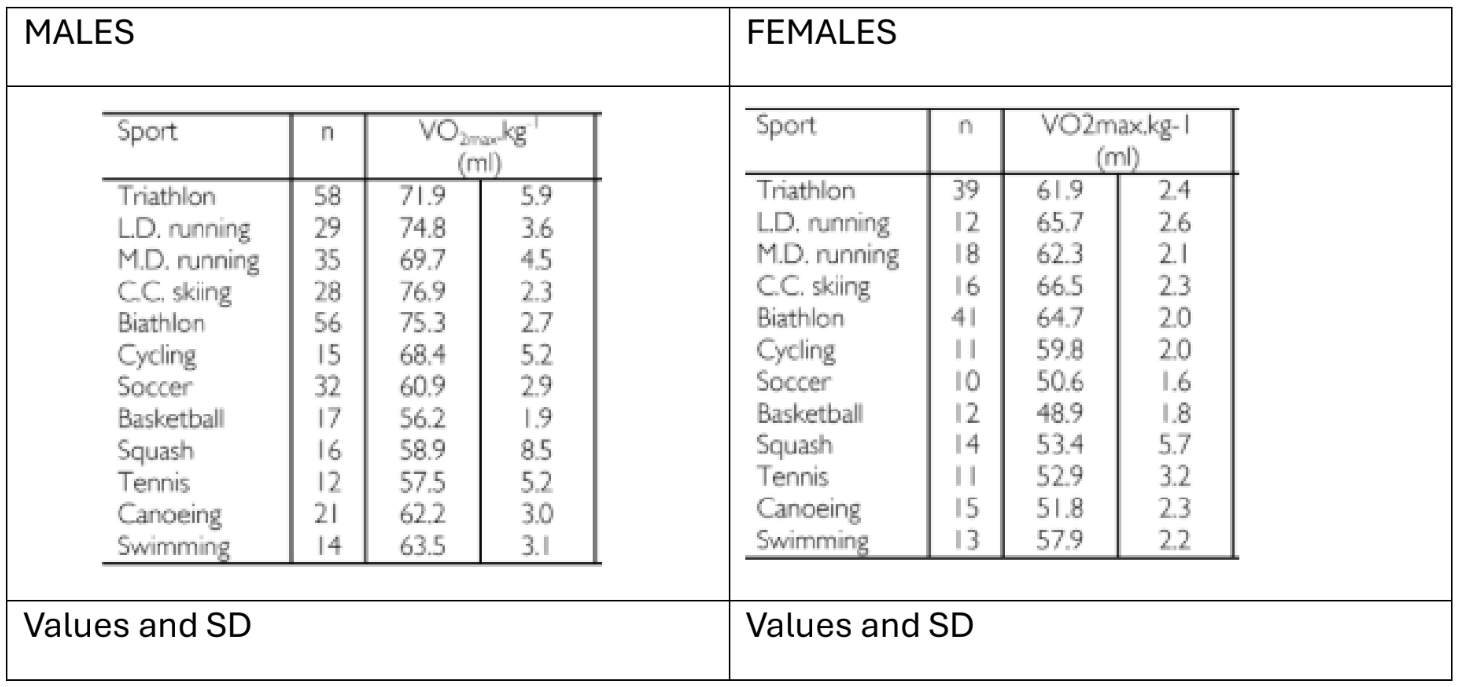
copied from Youth Sports by the Coimbra University (Portugal).
What we can see is that Australian triathletes have similar basic aerobic physiological capacity as many of the best triathletes in the Czech Republic, and it is a country with significant results in the European Junior environment. We can also see that triathletes have some of the highest aerobic capacities among sports, consistent training is essential to develop the basic aerobic need of the sport.
What I perceive as a game changer, is the constant thrive for quality work. Making the sessions count more and more without the need to add intensity to ensure focus and dedication. Remind yourself to train with purpose, to turn the brain ON. Doing this is not easy, it goes against a long-lasting marketing culture of "no pain, no gain". A culture far too present in Australian sport.
The road to the national podium is not to train longer or harder than the other guy. Most athletes already train too much and too intensely. The key is to train better.
Balog, A., Alföldi, Z., Horváth-Pápai, A., & Ihász, F. IMPORTANCE OF BASIC ENDURANCE IN TRIATHLON AT YOUTH AGE. Health Problems of Civilization, 19(1).
Bunc, V., Hráský, P., & Baláš, J. BODY COMPOSITION, FUNCTIONAL AND PERFORMANCE CHARACTERISTICS IN TOP CZECH YOUNG ATHLETES.
Papai, Z., Wilhelm, M., & Szakaly, Z. (2022). The new way of triathlon preparation in youth athletes. Journal of Physical Education and Sport, 22(10), 2589-2597.
