
There is generally an inverse relationship between VO2max and efficiency in running and cycling. Athletes with very high VO2 values tend to have lower efficiency and vice-versa.
In cycling, literature suggests that mechanical power output and pedal speed (defined as the relationship between crank length and cadence) are major determinants of metabolic cost in submaximal cycling. Both are markers of muscle shortening velocity making all factors which affect muscle shortening velocity highly important to cycling efficiency. Literature shows that repeated sprints (a characteristic of triathlon) impact submaximal cycling efficiency and subsequent running speed. Heubert et al (2005) have shown that a single 7s all out sprint can significantly decrease time to exhaustion at intensities slightly below and above critical power.
In running, efficiency is subject to three biomechanical gait phases: stance (foot on the ground), swing (foot in the air), and flight phase (both feet are floating off the ground). At 190spm the step duration is approximately 0.3 seconds with sub 200ms considered as optimal ground contact times. Meaning everything happens very quickly and small deficiencies can have large impact on energy cost.
Barnes & Kilding (2015) have shown high variability in running economy for male and female athletes. They highlight multiple factors interfering in running economy:
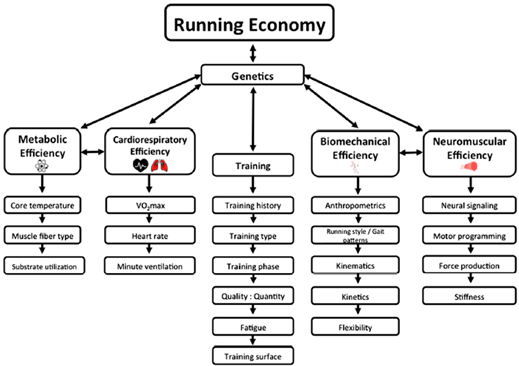
Factors influencing running economy (Barnes & Kilding 2015)
What is interesting to note is that the high variability is present in both sexes and at all levels of performance and VO2max:
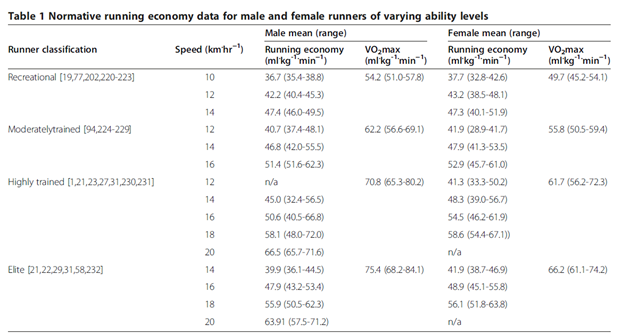
Normative data on running economy (Barnes and Kilding 2005)
What does this information tell us?
Let’s consider a situation with real life VO2max values for highly trained athletes.
Athlete A has a VO2max of 75ml/kg/min
When at 80% of their max (60ml), they run at 15km/h. (60/15 = 4ml/km/h)
This athlete has a very good engine and poor running efficiency
Athlete B has a VO2max of 60ml/kg/min
When at 80% of their max (48ml), equally at 15km/h. (48/15 =3.2ml/km/h)
This athlete has an average engine and average running efficiency
Athlete C has a VO2max of 52ml/kg/min
When at 80% of their max (41.6ml), at 15km/h. (41.6/15 =2.77ml/km/h)
This athlete has a small engine and great running efficiency
When training, their effort is the same (80% of max) at the same speed 15km/h. What if they are required to run at 20km/h (3min/km) to become competitive during their 5km competition? (5km races will usually be held at around 92% of VO2max)
Athlete A – 4ml/km/h x 20km/h = 80ml or a VO2max of ~86ml/kg/min
Athlete B – 3.2ml/km/h x 20km/h = 64ml or a VO2max of ~69ml/kg/min
Athlete C – 2.77ml/km/h x 20km/h = 55.4ml or a VO2max of ~60ml/kg/min
This means that if Athlete A is a male, he would need world class adult VO2max value to reach 3min/km pace if he doesn’t work on his efficiency. If Athlete A is a female, then she would need the highest ever recorded VO2max to reach the pace. If athlete B is either male or female, high but reachable values of VO2max are needed. For Athlete C, a 60ml/kg/min is easily achieved by a male and female endurance athlete with consistency in training.
If you look at the figure above, you will notice that sex is NOT listed as a major component of running economy. VO2max is important, but it is only the first differentiating factor between athletes. Performance development requires targeted training, and it can differentiate success from failure. Unfortunately, we see too many athletes only looking at the size of the engine going harder not smarter during training. The outcome is short lived performance gains and increased injury risk.
Speed at VO2max has a direct correlation to running economy. How fast you run when at your max effort can help you have a hint on your running economy when laboratory tests are not available. At Scatto Endurance we will translate your needs into performance.
Glauber Scattolini - MSpSc, BExSc&PE - ASCA L2 - AUSTri & AUS Cycling Dev.
REFERENCES
Heubert, R. A. P., Billat, V. L., Chassaing, P., Bocquet, V., Morton, R. H., Koralsztein, J. P., & di Prampero, P. E. (2005). Effect of a previous sprint on the parameters of the work-time to exhaustion relationship in high intensity cycling. International journal of sports medicine, 26(07), 583-592.
Barnes, K. R., & Kilding, A. E. (2015). Running economy: measurement, norms, and determining factors. Sports medicine-open, 1(1), 8.
